How to start forex trading as a beginner with a demo account, a broker and a written trading plan
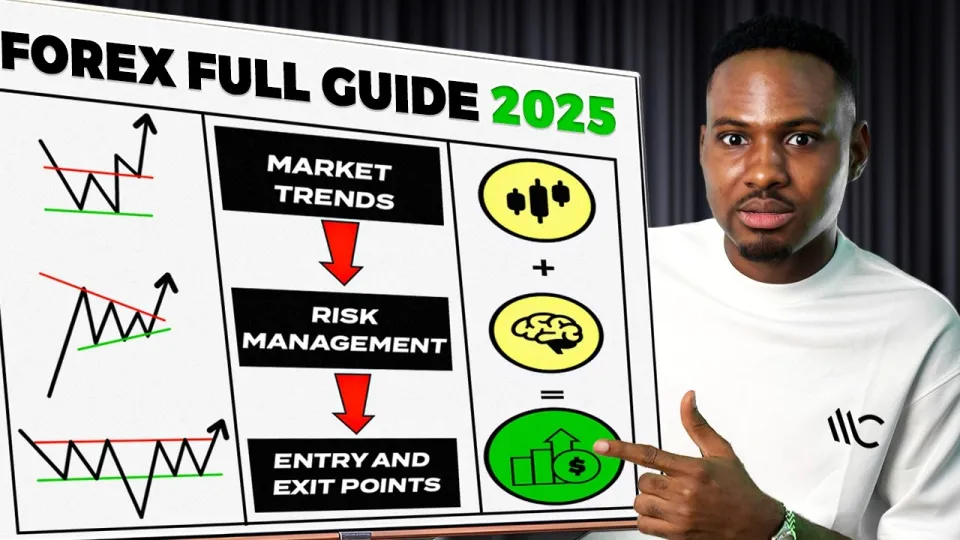
Video: How To Start Forex Trading For Beginners’ 2025 (Full Course)
Need articles like this for your video? They help promote it on YouTube and Google — order them in the Telegram bot @sat_sit_bot. It writes articles around your video, embeds the video and publishes them on popular niche websites (no ads). Try it free: 50 articles on us.
Key takeaways
- Forex is an over-the-counter market where currencies are quoted in pairs such as EUR/USD, and retail traders speculate on price changes rather than buying physical currency.
- Four sessions — Sydney, Tokyo, London and New York — overlap during the day, and the London–New York overlap is the busiest window for major pairs.
- A beginner needs three tools: a regulated broker account, a trading platform such as MetaTrader 5, and a trading journal for every position.
- Risk per trade should stay at 1–2% of account equity, with the stop-loss set before the order is placed.
- Jeffrey Benson Forex structures its beginner course around market basics, tools, strategy, a first trade and common mistakes.
Forex trading for beginners starts with three concrete steps: open a demo account with a regulated broker, learn how currency pairs and market sessions work, and write a trading plan with a fixed risk limit before you place any real order. You do not need a large deposit or a special indicator to begin — you need a platform, a rule set and a journal. The beginner course from Jeffrey Benson Forex follows the same path, and its student page is open at FirePips FX plans if you want to follow the full curriculum.
What forex trading actually is and how currency pairs are quoted
Forex is the global market where national currencies are exchanged, and retail traders take part by speculating on the price of one currency against another. Every quote is a pair: the first currency is the base, the second is the quote currency, and the number tells you how much of the quote currency buys one unit of the base. EUR/USD at 1.0850 means one euro costs 1.0850 US dollars.
Three details shape everything that follows:
- The market is over the counter — there is no central exchange, so your broker is your counterparty and its regulation matters more than any chart pattern.
- Prices move in pips, usually the fourth decimal place on most pairs; a move from 1.0850 to 1.0860 is ten pips.
- Leverage is expressed as a ratio, for example 1:100, and it multiplies both profit and loss on the margin you post, not on your whole balance.
The most traded pairs — EUR/USD, USD/JPY, GBP/USD and USD/CHF — are called majors and carry the tightest spreads. Exotic pairs such as USD/TRY or USD/ZAR can move violently on a single headline and are a poor first choice.
How the forex market works across the four trading sessions
The forex market runs 24 hours a day from Monday to Friday because trading simply moves between financial centres as each one opens. Sydney starts the week, Tokyo follows, then London, then New York, and the handover between London and New York is the period of highest liquidity and tightest spreads on major pairs.
Liquidity is not constant, and that changes how a beginner should schedule screen time:
- The Asian session is typically quieter, with range-bound movement in EUR/USD and more activity in AUD/JPY and NZD pairs.
- The London open often produces the day's first strong directional move.
- The London–New York overlap concentrates the largest volume, which suits strategies that need fast fills.
- The late New York session thins out, spreads widen, and stop-losses become easier to hit on noise.
Weekends are closed, but news does not stop: a central bank statement or an election result on a Sunday can gap the market at Monday's open. That is why holding leveraged positions over the weekend is a separate risk decision, not a default.
The tools a beginner needs before the first trade
A workable beginner setup is small: a regulated broker, a platform, a chart with two or three indicators at most, and a journal. Anything beyond that is optional until the basics are consistent.
- Broker. Check the licence, the regulator, client-fund segregation and withdrawal terms before depositing. The course author points beginners to Assex Markets and provides a registration link at https://my.assexmarkets.com/auth/register?partner_code=1699134; treat any affiliate link as a starting point for your own due diligence, not as a substitute for it.
- Platform. MetaTrader 5 (MT5) is the standard choice: it carries charts, order types, one-click trading and a built-in economic calendar. Linking a broker account to MT5 takes a server name, a login and a password supplied by the broker.
- Demo account. Trade the same instrument and lot sizes you intend to use live, for at least a few weeks, so the demo actually tests your plan rather than a fantasy version of it.
- Journal. Record the pair, direction, entry, stop, target, session and the reason for the trade. Reviewing twenty logged trades teaches more than twenty more videos.
- Risk calculator. Position size follows from the stop distance: risk in money divided by stop distance in pips gives the lot size. Doing this by hand once or twice makes the arithmetic obvious.
Building a basic forex strategy foundation
A strategy is a written set of conditions that tells you when to trade, where to exit and when to stay out, and it must be testable on past charts. Most beginner strategies are built from three components: a trend filter, an entry trigger and a fixed risk model.
A simple, repeatable template looks like this:
- Trend filter: mark the higher-timeframe direction, for example with a 50-period moving average on the four-hour chart.
- Entry: wait for a pullback to a level — a prior swing high or low, a round number, or a session open — and enter only in the direction of the filter.
- Stop-loss: place it beyond the structure that would invalidate the idea, not at a round number of pips chosen in advance.
- Target: set at least 1.5 to 2 times the stop distance so that a win rate below 50% can still be profitable.
- Risk cap: 1–2% of equity per trade, and a daily stop after two or three losses.
Before risking money, backtest the rules over at least 100 historical setups and log the results. If the numbers do not survive a spreadsheet, they will not survive live spreads and slippage.
Placing a first trade without breaking the risk rules
Placing a trade is a sequence of checks, not a single click, and the order in which you do them protects the account. Work through it in this order every time.
- Confirm the session and the news calendar — avoid entering minutes before a rate decision or a payrolls release.
- Set the stop-loss level on the chart first, then calculate the lot size that keeps the loss at 1–2% of equity.
- Enter with a market or pending order and attach the stop-loss and take-profit immediately in the same ticket.
- Screenshot the setup and write the reason in the journal while the trade is open.
- Leave it alone. Moving a stop-loss to avoid a loss converts a planned risk into an unplanned one.
On MT5 the position is opened from the order window with volume, stop-loss and take-profit fields filled in before confirmation; the platform then shows the risk in account currency, which is a useful final check.
Common beginner mistakes and the questions they raise
Most beginner losses come from process errors rather than bad analysis, and the same few errors repeat across every course comment thread. The most expensive is trading without a stop-loss or widening it once the trade goes against you — one such trade can erase twenty disciplined ones.
Other frequent problems:
- Overtrading. Taking five setups a day because the platform is open, instead of waiting for the one that matches the plan.
- Skipping the demo. Going live to "feel real emotion" before the rules are automatic.
- Ignoring risk management. Many learners say risk sizing was the piece they could not work out on their own; it is also the piece that decides survival.
- Copying signals blindly. Copying trades from a channel such as https://t.me/firepipsignals can be a learning aid, but if you cannot explain the entry, you cannot manage it when the provider is offline.
- Expecting speed. Forex is not a shortcut to a fixed income; the realistic goal in the first year is a stable process and a small drawdown.
Useful links from the course
- FirePips FX student plans — the author's paid mentorship and course page.
- Free daily signal channel — one trade idea per day, used by the author as a demo of his approach.
- Assex Markets registration — the broker link shared in the video.
- Premium signal group access — the bot used to subscribe to the paid group.
Bottom line on learning forex the slow way
Forex rewards a written process and punishes improvisation, so the beginner who spends a month on a demo account with a journal and a 1% risk cap is ahead of the one who deposits on day one. Start with one major pair, one session, one setup and a hard daily loss limit, then add complexity only after the results are documented. The full beginner course from the Jeffrey Benson Forex channel covers market basics, tools, strategy, a first trade and the mistakes to avoid, and it works best as a checklist you trade through rather than a video you watch once. If you want the structured route, the FirePips FX plans page is where the author puts his student programme.
Questions & answers
How much money do I need to start forex trading?
You can open a live account with a few hundred dollars at many brokers, but the amount matters less than the risk per trade. With a 1% risk cap, a $500 account risks $5 per trade, which is enough to practise execution and journaling without expecting meaningful income. Many beginners stay on a demo account until the process is consistent.
Is forex trading legal and safe for beginners?
Retail forex trading is legal in most countries, but safety depends on the broker's regulation, client-fund segregation and withdrawal record, not on the market itself. Leverage is the main structural risk: at 1:100 a 1% price move against a fully leveraged position wipes out the margin. Verify the licence before depositing and never fund an account with money you cannot afford to lose.
How long does it take to become profitable in forex?
There is no fixed timeline, but the realistic path runs through months of demo trading, a backtested strategy and a journal of at least a few dozen logged trades before live results mean anything. Traders who treat the first year as process-building rather than income-building tend to last longer than those chasing a fast doubling of the account.
Can I just copy trades from a signal channel instead of learning?
Copying signals can show you how a professional structures entries, stops and targets, but it does not teach you what to do when the provider is unavailable or the market regime changes. If you copy, size the position yourself, keep a risk cap and record every copied trade in a journal so the experience still becomes your own.
Source: How To Start Forex Trading For Beginners’ 2025 (Full Course) · Markdown version