Meme coin trading works better when you size positions small, buy consolidation and treat every launch as a lottery ticket
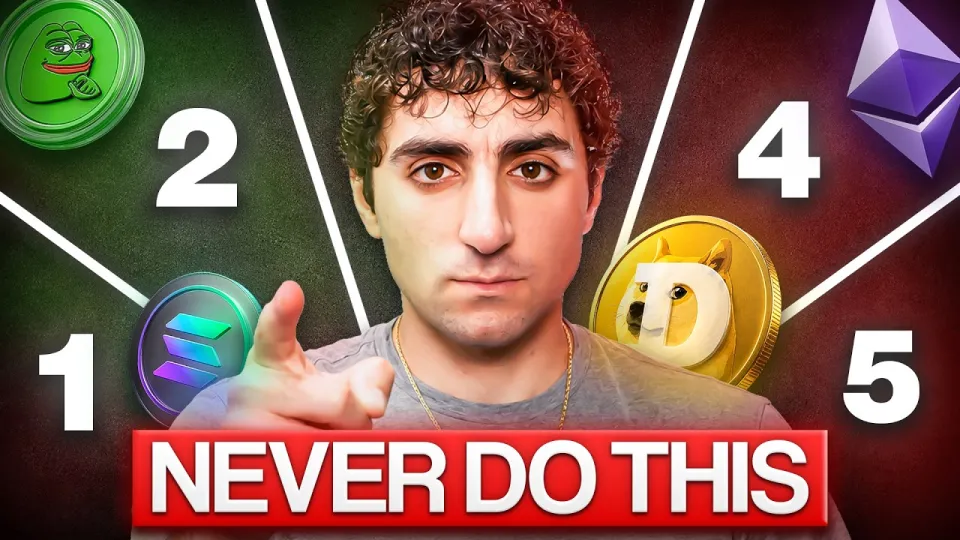
Video: 5 Things I Wish I Knew Before Trading Memecoins (Learn From My Mistakes)
Need articles like this for your video? They help promote it on YouTube and Google — order them in the Telegram bot @sat_sit_bot. It writes articles around your video, embeds the video and publishes them on popular niche websites (no ads). Try it free: 50 articles on us.
Key takeaways
- Meme coins are lottery tickets, not investments: size each position so a total loss costs less than 1-2% of the portfolio.
- Boredom trading is the most common account killer; a viewer lost an entire portfolio in a bear market purely out of boredom.
- The best entries come during consolidation, before the crowd arrives, not on the green candle everyone is posting about.
- Check liquidity and holder distribution before buying: thin pools and one wallet holding a large share make an exit impossible.
- Set a sell plan before entry: take initial capital out early and let only house money ride.
A meme coin is a token with no cash flow, no product and no fundamental valuation, so it should be traded as a lottery ticket rather than an investment: the only edge a retail trader has is position sizing, patience and a pre-written exit plan. The most useful checklist for anyone entering this market comes from the rasmr breakdown "5 Things I Wish I Knew Before Trading Memecoins", and the trading venue referenced in that video is available through the fomo.family registration link.
What a meme coin actually is and why the odds are stacked against you
A meme coin is a token whose price depends entirely on attention, liquidity and the willingness of the next buyer to pay more, which means supply and demand mechanics matter far more than any narrative. There is no earnings report to model, no discounted cash flow, no roadmap that constrains the price. Value is reflexive: price rises because people buy, and people buy because price rises.
That structure produces a specific distribution of outcomes. A small number of launches produce enormous percentage gains, and the long tail goes to zero. Most participants sample the long tail first, because the tokens that trend on social media are usually the ones already up several hundred percent, which is precisely when the risk-to-reward has inverted.
Three features define the risk profile of any launch:
- Liquidity depth. A pool with a few thousand dollars of liquidity cannot absorb a meaningful sell without collapsing the price.
- Holder concentration. If a handful of wallets hold a large share of supply, those wallets control the chart.
- Mint and freeze authority. If the contract still allows the deployer to mint new tokens or freeze trading, the supply you bought is not fixed.
None of these require deep technical skill to check. They require the discipline to check them before buying instead of after.
Size every position so a total loss is boring
The single decision that separates traders who survive a year in this market from those who do not is position size, because a meme coin can go to zero and the portfolio has to absorb that without changing your behaviour. If a losing trade makes you anxious, angry or eager to win it back, the position was too large regardless of how good the setup looked.
A practical rule is to cap any single meme coin position at an amount you would comfortably spend on entertainment, typically 1–2% of trading capital. That framing does the psychological work: a full loss is annoying, not destabilizing. It also keeps you in the game long enough to learn the pattern recognition that only comes from repetition.
Oversizing has a second, less obvious cost. It pushes traders into monitoring charts constantly, which creates the urge to act. A viewer in the comments described losing an entire portfolio during a bear market not because of a bad thesis but because of boredom, which is the most common version of this failure. Boredom is a position-sizing problem before it is a discipline problem.
Buy during consolidation, not on the green candle
Consolidation is the phase where a meme coin trades sideways in a tight range after an initial move, and it is generally the only place where a retail buyer gets an acceptable entry, because the crowd has not yet arrived and the stop level is clearly defined. Buying a token that is already vertical means paying for someone else's exit.
A workable process looks like this:
- Wait for the first impulsive move to finish and for volume to dry up.
- Mark the range high and range low of the sideways period.
- Buy near the lower half of the range, not the upper edge.
- Place the invalidation just below the range low, where the consolidation thesis breaks.
- Skip the trade entirely if the range is too wide relative to your stop distance.
News and catalysts can confirm a move, but they are a poor entry trigger on their own, because by the time a catalyst is public the price has usually already repriced. The comment section of the video reflects this directly, with newer traders asking whether to buy during consolidation or wait for confirmation such as positive news. The honest answer is that consolidation gives you the risk definition, while news gives you the reason other people will buy after you.
Read liquidity and holder data before you click buy
Liquidity and holder distribution are the two numbers that determine whether you can exit a meme coin at a price close to what the chart shows, and both are visible before you enter. A chart is a record of the last trade, not a promise about the next one.
What to check on any launch:
- Pool size relative to your intended position. If your order is a large fraction of the pool, you are the market.
- Top holder share. Wallets tied to the deployer or to snipers are the ones that sell into your entry.
- Trading history. A token with a handful of transactions has no price discovery, only a quote.
- Contract permissions. Revoked mint authority and no freeze function remove the most direct rug vectors.
This is also where the practical difference between a centralized exchange listing and an on-chain pool shows up. On-chain pools give you early access and full transparency about supply, but they also let you be the exit liquidity for a wallet that bought the first block. The trade-off is speed versus safety, and it should be a deliberate choice rather than a reflex.
Write the exit before you write the entry
An exit plan is a set of pre-committed sell levels and conditions defined before the position is opened, and it is the only thing that reliably prevents a winning trade from turning into a round trip. Meme coins move fast enough that in-the-moment decisions are usually emotional decisions.
A simple structure covers three scenarios. First, sell enough at an early multiple to recover the initial capital, which converts the position into a free option. Second, scale out a portion at a predefined target rather than waiting for a number that feels satisfying. Third, define what happens if the token stalls: a time stop, such as exiting if the thesis has not played out within a set number of days, prevents capital from being parked in a dead chart.
Trailing stops are useful once a token is in price discovery, but they need to be wide enough to survive normal volatility in a market where 30% swings are routine. A stop that gets hit by noise is worse than no stop, because it teaches you to override your own rules.
Common questions from newer meme coin traders
The questions that come up most often from people in their first months are about patience, timing and whether the whole activity is worth it. A recurring theme in the comments is that the game is largely about waiting, and that the costly mistakes tend to happen in the first few weeks when every launch feels urgent.
Another frequent concern is whether the advice applies to a small account. It does, and arguably more so: with less capital, the cost of a single oversized loss is proportionally larger, so the sizing rules matter more rather than less. Traders who have been at it for a month and recognize their own mistakes in a checklist are in a better position than those still looking for a signal group, because the correction is behavioural rather than informational.
The bottom line on trading meme coins
Meme coin trading rewards process over prediction: small positions, entries during consolidation, liquidity and holder checks before buying, and an exit plan written in advance. The rasmr video is built around exactly this gap between what new traders expect and what the market actually delivers, and it is worth watching as a companion to this checklist. The venue linked in that breakdown is reachable through the fomo.family referral page if you want to trade with the setup described. None of this removes the risk of total loss, but it makes the losses small enough to learn from.
Questions & answers
How much of my portfolio should go into a single meme coin?
Most experienced traders cap a single position at roughly 1–2% of trading capital, so a total loss is annoying rather than destabilizing. The right number is the one that lets you keep following your rules after the token goes to zero. If a position makes you anxious or eager to win it back, it is too large.
Should I buy during consolidation or wait for news confirmation?
Consolidation gives you a defined risk level, because the range low marks where your thesis is wrong. News confirms that other buyers will arrive, but by then the price has usually already moved. Buying the lower half of a sideways range with a stop below it is generally the better risk-to-reward setup.
Why do so many traders lose money out of boredom?
Boredom creates trades that have no setup, which means no defined risk and no edge. One common pattern is losing an entire portfolio in a quiet market simply because nothing was happening and every launch felt like an opportunity. Fewer, better-sized trades fix most of this.
What should I check before buying a new meme coin launch?
Check pool liquidity relative to your order size, the share held by the top wallets, whether mint and freeze authority are revoked, and how much real trading history exists. Thin pools and concentrated holders mean you may not be able to exit at the price shown on the chart.
Source: 5 Things I Wish I Knew Before Trading Memecoins (Learn From My Mistakes) · Markdown version